
Last week, Lady Gaga released a music video for her song, “911,” using iconography and influences from Sergei Parajanov’s 1969 film, “Sayat Nova,” (better known for its censored name, The Color of Pomegranates) based on the life of the Armenian poet, Sayat Nova. This video comes at a unique time, as the conflict between Armenia and Azerbaijan was only recently recommenced.
Sergei Parajanov was a unique and revered filmmaker that most people likely haven’t heard of. Before last night, I had no idea this filmmaker, or this film, existed. He was arrested multiple times by the KGB over the course of his life, spending several years behind bars on charges of “leaning towards homosexuality,” black marketing, and tendency towards suicide. These charges are often disputed as being fake, as Soviet censors attempted to keep Parajanov from making films. Out of prison, Parajanov continued to make some of the most poetically and artistically charged films of all time.
Last night, I saw a tweet linking the full film online, noting that the film was an Armenian classic and was a “poem” in itself. As a poet, I had to confirm this for myself. LORD y’all, they were right. This film is pure and unadulterated poetry in motion. Only a little over an hour-long, this low-budget film uses “dollhouse-like” sets with bright pastel colors, evocative, traditional Armenian costumes, and religious iconography to tell a story with hardly any words. There are only a few other movies that have truly drawn me in like Parajanov’s has, and I guarantee you haven’t watched something like this before (think Wes Anderson without dialogue, and on drugs, and kidnapped by a religious cult).
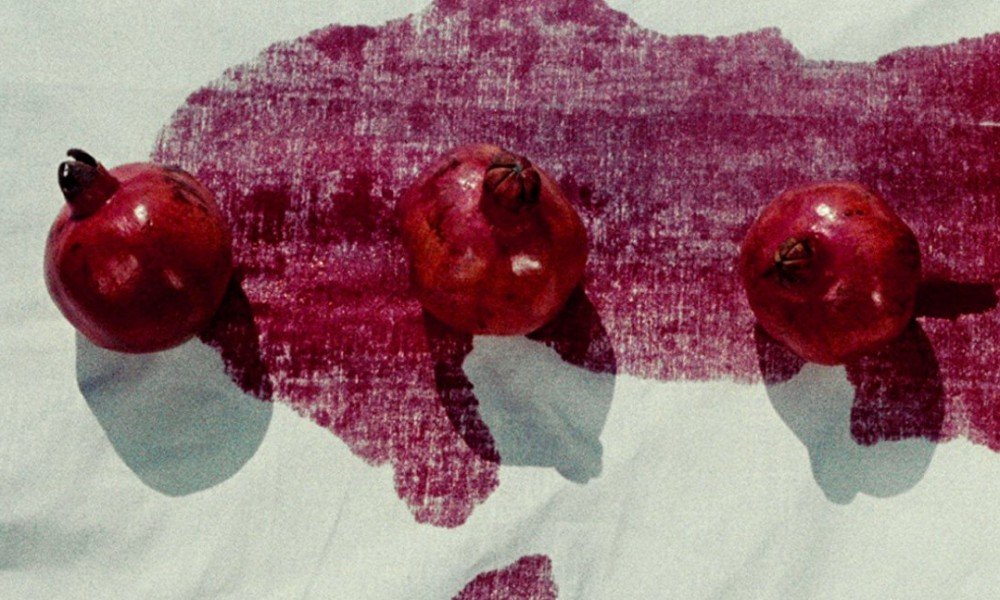
The film opens with the image of pomegranates and a knife bleeding pinkish-red into fabric, as the speaker (I assume is meant to be the poet, Sayat Nova, as the words/dialogue are driven by his poems and songs) whispers “I am the man whose life and soul are torture.” It follows a nonlinear format, moving between the poet as a child, as a youth, and as an old man. There is a fluidity that can’t quite be explained with words. Life and death become synonymous on the screen, as children are baptized, men and women work, goats are slaughtered, and Sayat Nova and his muse/lover (played by the same actress, Sofiko Chiaureli) stare intensely at the viewer while wearing a variety of Armenian outfits.
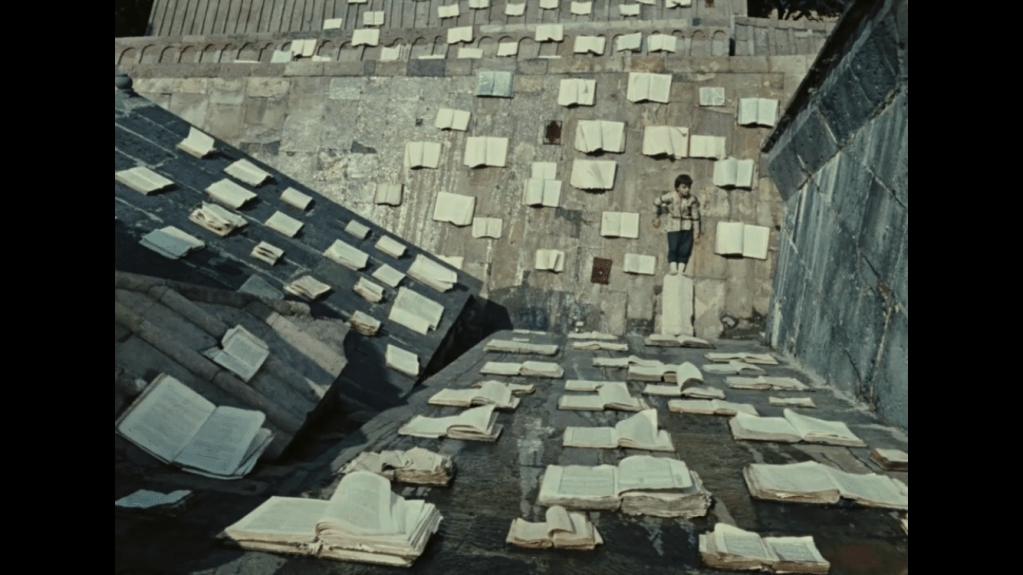
Sergei Parajanov is an artist and a poet at heart, as he said, “When I fell into the worst possible prison conditions, I understood I had a choice: either I would go under, or I would become an artist. So I began to draw. I brought with me out of prison 800 works.” He realized that he could transform pain and sorrow into art and poetry, and you can see that clearly in Color of Pomegranates. There aren’t many words spoken in this film but the ones that are are steeped in melancholy. Towards the end of the film, Sayat Nova as an old man walks a horse across the screen, as the narrator says “The world is like an open window, and I am weary of passing through it.” Scenes of animals being beheaded juxtaposition the poet’s actual life, in which he was executed and beheaded for converting to Christianity.

After making his film, Shadows of Our Forgotten Ancestors, Parajanov said he discovered his style: “That’s when I found my theme, my field of interest: the problems faced by the people. I focused on ethnography, on God, on love and tragedy. That’s what literature and film are to me.”
There is a quiet passion that hums below the surface of each scene in Pomegranates, much like how the best poetry can carry with it a soft intensity or a pulsating strength. As a queer person, I would even argue that much of the imagery in the film is queer in its genderfluidness, especially considering the actress Sofiko plays both the male poet and his female lover. Their scenes are overlapping, as in one scene where Sayat appears in blue and white, passes a hand over his face and the scene cuts to one of his lover, wearing the same colors, as if they are one and the same in love and expression.
It’s not a film that will please everyone, and I’d say you have to be in the right frame of mind for it. I’d go into it expecting a museum of art, not a plot-driven film. Parajanov said, “I think Sayat Nova is like a Persian jewelry case. On the outside its beauty fills the eyes; you see the fine miniatures. Then you open it, and inside you see still more Persian accessories.” Parajanov was also influenced by filmmakers like Andrei Tarkovsky, so expect to be induced into a dreamlike state, best enjoyed late at night with a glass of wine and maybe some funny cigarettes.
Either way, this film is stunning. It needs no poem because the film in itself is a poem.

 Elisms